.jpg)
Modi government has taken some interesting policy decisions in the 100 days since the time he met President Pranab Mukherjee to present his claim as Prime Minister of the world's largest democracy, says Tanmaya Nanda.

The counter-insurgency operation on the Indo-Myanmar was under planning for the last three months. The June 4 ambush that killed 18 Indian soldiers only hastened the attack. Sheela Bhatt provides exclusive details of the planning for the operation.

As Chinese army incursions continue to recur, India has cautioned China that any disturbance of peace and tranquility in the border areas can vitiate the overall atmosphere of bilateral ties.

'If you say I won't talk to them at all, does terrorism stop?' 'Even if they say they will give up terrorism, "I will fight terrorism along with you," but even then you say I still won't talk to you until you do the following things, then that is a political call.'

Prime Minister Narendra Modi's spin doctors are on an overdrive these days to project him as a "tough talking" leader following a spate of critical media reports about his sudden silence on key issues, says rediff.com contributor Anita Katyal.

'If, as appears to be the case, India is on way to 'mending fences' with China, and China is equally desirous to 'reset' the relationship, this could be a self-reflexive moment in India's positioning vis-a-vis not just the Dalai Lama, but also the Tibetan issue and China as a whole,' points out China expert Alka Acharya.

The city readies itself for the biggest economic, political and social event of the year

And the US won the evening

'If at all,' says Suhasini Haidar, Foreign Affairs Editor, CNN-IBN, 'Devyani Khobragade is to avoid facing a full trial, the process of that negotiation must start immediately, for which the current acrimonious atmosphere must be improved. It is no more than the US was willing to do for Raymond Davis; the Italian government for its sailors; and India for Captain Sunil James and Vijayan in Togo. Devyani Khobragade is not accused of charges anywhere as serious they were, and whether Preet Bharara's office recognises it or not, she is a diplomat who represents a proud country that has taken the insult to her as a personal insult to the country.'
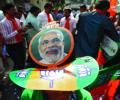
Retired senior US diplomats Teresita and Howard Schaffer believe the 'US cannot afford to continue restricting its contacts with Narendra Modi.' Rediff.com's Aziz Haniffa reports from Washington, DC.

What is Narendra Modi like? What is his politics about? What will he do? What are his priorities? Sheela Bhatt/Rediff.com speaks to Swapan Dasgupta to find out more about the man of the moment.

11th-hour debt restructuring programme offered no concessions to creditors

The prime minister should have visited Sri Lanka, armed with a critique of the Rajapakse government based on nuance and fact, says Sreenivasan Jain

'India needs to deeply introspect on the costs of pursuing peace with Pakistan,' says Lieutenant General Syed Ata Hasnain (retd).

If the aim is to become a player with some strategic space of its own, not just in the Indian Ocean region but also in the adjoining region, then greater interaction with China is desirable, even necessary.

His sartorial taste is not something he acquired suddenly as the chief minister of the prime minister. His "god-given" dress sense is like his politics: inventive, imaginative if slightly unconventional, often loud. It goes well with his oratory, robust persona and penchant for coining terms, says Mahendra Ved.

"Who will be his men?" a distinguished official close to the prime minister asked. Frankly, nobody has an idea. Hardly seven weeks are left for a regime change, but the idea of Narendra Modi on Raisina Hill looks abnormal, if not unreal. Rediff.com's Sheela Bhatt captures the uncertain mood in the capital's bureaucracy ahead of the largest democratic transfer of power in the world.

Contentious issues such as the construction of a Ram Temple in Ayodhya, abrogation of Art 370 giving special status to Jammu and Kashmir and enactment of Uniform Civil Code have been included in the Bharatiya Janata Party's election manifesto with the party making promises on them.

The India card is now almost obsolete. There are more pressing challenges. People of Pakistan are fed up with years of bad governance, corruption and broken promises of successive governments. However, the politicians and former generals are still provoking sentiments on what is happening on the Line of Control for petty political gains, says Shahzad Raza.
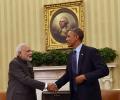
Narendra Modi would have done well to take a few more months before he agreed to receive or call on heads of countries like Japan, China, and the US. The prime minister is to settle down in his job and it was too soon for him to have full awareness of the nuances of intricate international issues, says B S Raghavan.

India comes under attack over religious intolerance, human trafficking and slavery at a Senate Foreign Relations Committee hearing.

'We should hit Pakistan, continue to prepare for surgical strikes, continue to punish Pakistani posts in the proximity of the LoC and we should start adopting counter terrorist measures.' 'That should be India's action without escalating it to a full-fledged war.'

'To expect that he has a magic wand to resolve all differences and announce breakthroughs in all issues during his first visit to the US is to be unrealistic,' says Ambassador T P Sreenivasan.

'What if Modi becomes the fascist the leftists paints him as? What if he does suspend the Constitution and declares himself the ruler, with support from the army? What exactly will you do, Mr Leftie?' asks Rajeev Srinivasan.

In his penultimate State of the Union address, Barack Obama said that the economy is improving.

Sushma Swaraj's suave moves helped Narendra Modi pull off a diplomatic coup, helping regain her standing.
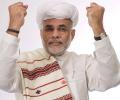
Two former senior United States diplomats, with more than 60 years experience in South Asia between them, have exhorted Washington to establish communication with Bharatiya Janata Party's prime ministerial candidate Narendra Modi sooner than later.

If the chemistry between Modi and Xi Jinping goes well, it will herald a new future not just for the region but for the world, says Tarun Vijay.

How much money the Modi government has already spent and is going to spend on all those foreign trips, muses Sunita Iyer

The Security Council as it is today is unable to bring peace and security in the world and so there is reason for countries like India to become members of the Council, Ambassador Asoke Kumar Mukerji tells Sheela Bhatt/Rediff.com.

Here's the full text of Prime Minister Narendra Modi's address to the United States Congress.
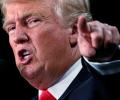
The US foreign and security policy establishment, says Ambassador M K Bhadrakumar, apprehends that Trump may compel them to exorcise the 'unipolar predicament', and bring foreign and security policies to reflect the desires and priorities of the American public.

'Chinese leaders rarely receive their foreign guests in cities other than Beijing. Such respect for India!' 'Does it mean that Modi could replicate "the warmth and unconventional way" by sending Indian troops into Tibet, as Xi did in Chumur (Ladakh) when he arrived in India? Of course, Indians are far too polite to do so,' says Claude Arpi.

Is Being Human, the actor's apparel brand, an extension of his persona or is it a move to correct his bad-boy image?

'Those who have seen the functioning of the Modi government in Gujarat know that the issues related to Hindutva and issues of economy and growth function simultaneously.' 'Modi's politics are based on the understanding of the middle-class consumer society which is in pursuit of material aspirations.' Sheela Bhatt/Rediff.com reveals the Modi government's economic and political plans for the year ahead.
'As the first leaders of their respective countries born after Indian Independence and the Chinese Liberation, Modi and Xi would be expected to have the ability to overcome the traditional mindsets and the hierarchical nature of their official/bureaucratic establishments,' say Alka Acharya and Jabin T Jacob.

'In the first meeting of this new year, we took a joint new year resolution that we will complete it this year. At the time things were not very clear, but the mood was clear that yes, we must resolve it.' 'Yes, details have to come out, but there are some sensitivities, there are some stake-holders not yet on board, especially other Naga undergrounds etc, we would like them to come on board... So at a proper time it has to be revealed to the country, and to the legislature. Perhaps, we may have to wait for some more time.' 'With better understanding of the Indian system, many of them have learnt, realised, appreciated that Naga nationalist aspirations can be accommodated in the Indian system. The Indian system is pretty comprehensive and flexible.' 'A Naga has as much stake, claim over India as any other Indian. There is no distinction. This, Nagas have realised, that yes, Naga nationalist aspirations and Indian nationalism are not mutually exclusive.' Ravindra Narayan Ravi, the Government of India's Special Interlocutor for the Naga talks, explains how the Naga Peace Accord was reached in an exclusive interview to Saisuresh Sivaswamy/Rediff.com

'Today if you look at the way India is growing many people are saying the sleeping elephant has finally woken up, is dancing!' 'I have travelled extensively, in about 60 countries. In all these the moment you say India, the first thing they mention is either an actor's name. Or they start humming a song.' 'I wanted to be in Bollywood. It is the most powerful medium we have in this country. That's soft power.' Listening in on Shobhaa De, Kabir Khan, Vikas Swarop and Saffron Art CEO Hugo Weihe speak on India's Soft Power, Hard Influence.

New Delhi and Beijing are the only two regional capitals that have commented on US President Donald Trump's speech on August 21 outlining the way forward in Afghanistan. The Indian foreign ministry statement was effusive in praise, while the Chinese statement has been one of cautious and guarded hope. Delhi has identified itself with Trump's Afghan strategy, whereas the Chinese stance is calibrated -- observant and objective, keeping a distance, says Ambassador M K Bhadrakumar.
The kind of people Narendra Modi has chosen, the decisions he has taken and the rail and central budgets suggests that he is treading carefully in New Delhi. There is less of innovation and more of continuity, so far. He is not ready to rock the boat and start from scratch, says Sheela Bhatt.
